Thursday, March 17, 2011

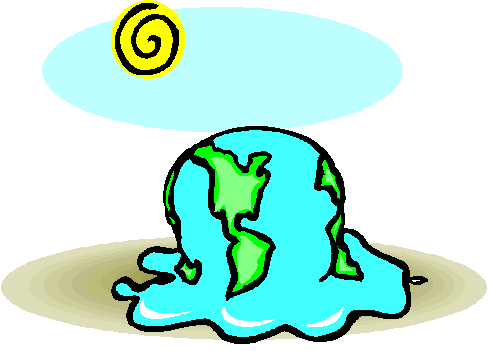
Global Warming - Burning My Iceland

Living on a tropical island, is quite unique. If you love the natural world, there are many things you could do it. I grew up in a small valley in the hills south of my island and I have known my whole life.

Field trips to a pretty fast pace of the canyon hills hundred meters is all worth it when I have to choose a place near the top only. It is a true blessing to be able to do. It is a wonderful job, too. The tops of steep hills to near the base is covered by savannah grasslands. The very steep slopes and along its base are wooded ravine. More than jungle delirium. If you look in the mountains in the distance, are the golden color of the meadows a great contrast to the dark green jungle hills. It is amazing to know how my mind that a hundred years ago, almost all of these dark hills. Jungles all the way up. Wow. And one reason why not.

Fire was a tool for humans used almost since its discovery. He also has done before. And one of the biggest weapons for hunting deer has become here in the jungles of the south. What they do is a fire. Just set a fire the flame and let it rip. Help if you would have difficulties. For once it's gone and burning in arable soil, a wonderful thing called life happens next. New shoots of grass from the hills and burned black. And the deer is probably a surprise, because they consume these tender buds. The wild hunter waits.

Oh, but all the other things that there was kindled a fire in the hills happened. Surely this is not the arsonist would have thought about it. Let us straight in the direction that things go happen. The fire is determined and set on fire. The atmosphere is the first hit. A powerful greenhouse gas (carbon dioxide), a by-product of combustion of vegetation is directly exposed to the atmosphere. But wait. We do not really feel their effects for a long time. No, not right. Global warming. Exactly. It is not surprising that the collective memory of vegetation in the world is still a significant contribution to global warming? his strike.

While in the flames, a fire are often lost in a jungle. The fire will stop, right? That is true. The last time. But the fire will not die once they walk into the jungle. He has to burn its way into a little "to run into the water and most of the jungle. You know, it will take at least one meter. Do burnout. So how can you burn burn, walking to the size of forests . The more you burn, the less the jungle. Strike two.

Now, the fire died and the hills are bare. When the rain comes, and then the soil to wash away. I have never burned washed flee a hill by the rain. Soil erosion by sedimentation in water. But that does not matter. The ocean is big. Will not hurt. In the grand scheme of the oceans, not too much. For aquatic life in rivers, coral, and the open sea populations that feed and live on these reefs, the damage is absolutely fatal. Strike three.

Add all. We have professionals on the one hand, the shot immediately after a new fire is enticing deer. It would be easier to catch. And only useful for the hunter. We are opposite on the other side, and the list is impressive.

- The air in our atmosphere gets an infusion of a potent greenhouse gas that contributes to global warming. We know without doubt that large and persistent global warming has caused and is accelerating, climate change may very well end our day.

- It is the country. Our lower jungle. This quickly leads to loss of habitat for animals. The bright green jungle of our gold and the sea of our savannas are burned from the hills of text and black. All animals, nests or caves caught fire, food, well, that's just their loss. And if it rains, we lose our topsoil. The roots in the city, burned clean. accelerated soil erosion, I despise. .

- It is the sea, rivers are included. Immediately after the soil erosion is the effect of sedimentation. This transported soil spreading. And blankets and suffocates when it finally stabilized. Sedimentation is the bearer of death for microscopic organisms, plants, fish and corals, to say the least. In the aquatic environment, is the destruction of large and extended. Imagine that your air is filled with the ashes of all time. What would be the quality of your life, what then?

He has about 700 million tons of carbon dioxide into the atmosphere every day. There is no doubt, no debate. A large percentage comes from the constant reminder of the natural landscape. We have to change the way they do things.

The survival of our race, have to stop global warming. Climate change in progress should be maintained, if not reversed. If we refuse to realize this, it will matter in fifty or a hundred years? Spread the word. Take part. We can still save.

Proof of Evolution and challenges of global warming


The idea of anthropogenic global warming is under fire in recent months. Those who collect and disseminate information, it was discovered the numbers have changed, so that man is warming seems to be done.

Some of these "scientists" are now conceded that the data shows global warming has not happened since 1995.

Thousands of scientists have provided information that the idea of artificial contradiction with global warming. Only recently has this idea confirmed.It-against has been shown that global warming scientists "have falsified data. This is already accepted.

This reveals the fact that politics can affect the results of some scientists. Ie. Scientists are not all looking for a little 'practice.

Our world, of course, seems to be cooling or heating. This site is for thousands of years. However, until now, there is no evidence that humans are the trends van deze case (solar activity seems to be the TE Meest scientific explanation).

It 's amazing how the idea of man and global warming seems to Darwinian evolution made in parallel with each other.

O data and information was collected mainly in universities and government institutions (this is the fox guarding the hen house?).
or Both make use of ad hominem attacks, like the call of the opposition "flat earthers" or other names.
Opponents or are prohibited by most of the original data. I'm just not allowed much of the information used to support the ideas seen.
o The two have strong support from the media, despite the fact that the scientific evidence against two ideas overhelmingly
or Both are strongly encouraged in public schools and universities.

It is easier to transmit data on global warming to find (even if the data were kept secret years) is that Darwinism Because dealing with the evolution of different aspects of science.
The person is interested in digging beneath the surface of normal university or high school during the next hoaxes (or science just terrible) was used to "prove" the theory of evolution.

or Piltdown Man, a creature with characteristics of both humans and monkeys. Used for four decades, the theory of evolution is to take hold "in the United States until someone discovered that the" monkey-man'was formed by mixing of two monkeys and human bones were found with the bones as they age, filed teeth, etc.
Or Nebraska man was a man-ape of high-profile ", used in the test Sccopes (high profile). It 'very instrumental in establishing the idea of man evolving from apes. Following this" monkey man "was shooting with a single tooth of an extinct pig.
or embryos Haeckel was a chart with various vertebrates that "all steps in the evolution" in its infancy (which is also the same phase of Gill). This image is a hoax at the end of 1800. (Although we still found in many textbooks today).

These hoaxes and bad science are not the exception. There are literally dozens of scientific laws, principles and facts that directly contradict the theory of evolution.

Statist regimes (including Nazism), socialism and communism are all based on the Darwinian theory of evolution (in particular to eliminate the idea of Judaism and Christianity). Their posters often include the theory behind their ideas.

Today it seems that the same people behind the artificial global warming is pushing the idea of evolution.

Unless something beneath the surface of typical hand, we remain convinced of information that educators and politicians for decades teaches us that both ideas.

Politics and science do not mix. And if they do not mix together, always knowing that suffers at the expense of politics. Recent discoveries have shown that the "science of man-made global warming is seriously compromised. With all the facts that we discover the trend, it seems that the same happens with it as well.

For some form of evolution is clear evidence to support the theory, Darwinism is more than likely continue on the same track as the man who took the global warming. It could also last for many decades, however, the current serious problems of evolution to the public.

Wednesday, March 9, 2011

How To Stop Global Warming

Global Warming is a dramatically urgent and serious problem. We don't need to wait for governments to find a solution for this problem: each individual can bring an important help adopting a more responsible lifestyle: starting from little, everyday things. It's the only reasonable way to save our planet, before it is too late.


1. Replace a regular incandescent light bulb with a compact fluorescent light bulb (cfl)
CFLs use 60% less energy than a regular bulb. This simple switch will save about 300 pounds of carbon dioxide a year.
We recommend you purchase your CFL bulbs at 1000bulbs.com, they have great deals on both screw-in and plug-in light bulbs.


2. Install a programmable thermostat
Programmable thermostats will automatically lower the heat or air conditioning at night and raise them again in the morning. They can save you $100 a year on your energy bill.


3. Move your thermostat down 2° in winter and up 2° in summer
Almost half of the energy we use in our homes goes to heating and cooling. You could save about 2,000 pounds of carbon dioxide a year with this simple adjustment.


4. Clean or replace filters on your furnace and air conditioner
Cleaning a dirty air filter can save 350 pounds of carbon dioxide a year.


5. Choose energy efficient appliances when making new purchases
Look for the Energy Star label on new appliances to choose the most energy efficient products available.


6. Do not leave appliances on standby
Use the "on/off" function on the machine itself. A TV set that's switched on for 3 hours a day (the average time Europeans spend watching TV) and in standby mode during the remaining 21 hours uses about 40% of its energy in standby mode.


7. Wrap your water heater in an insulation blanket
You’ll save 1,000 pounds of carbon dioxide a year with this simple action. You can save another 550 pounds per year by setting the thermostat no higher than 50°C.


8. Move your fridge and freezer
Placing them next to the cooker or boiler consumes much more energy than if they were standing on their own. For example, if you put them in a hot cellar room where the room temperature is 30-35ºC, energy use is almost double and causes an extra 160kg of CO2 emissions for fridges per year and 320kg for freezers.


9. Defrost old fridges and freezers regularly
Even better is to replace them with newer models, which all have automatic defrost cycles and are generally up to two times more energy-efficient than their predecessors.


10. Don't let heat escape from your house over a long period
When airing your house, open the windows for only a few minutes. If you leave a small opening all day long, the energy needed to keep it warm inside during six cold months (10ºC or less outside temperature) would result in almost 1 ton of CO2 emissions.


11. Replace your old single-glazed windows with double-glazing
This requires a bit of upfront investment, but will halve the energy lost through windows and pay off in the long term. If you go for the best the market has to offer (wooden-framed double-glazed units with low-emission glass and filled with argon gas), you can even save more than 70% of the energy lost.


12. Get a home energy audit
Many utilities offer free home energy audits to find where your home is poorly insulated or energy inefficient. You can save up to 30% off your energy bill and 1,000 pounds of carbon dioxide a year. Energy Star can help you find an energy specialist.


13. Cover your pots while cooking
Doing so can save a lot of the energy needed for preparing the dish. Even better are pressure cookers and steamers: they can save around 70%!


14. Use the washing machine or dishwasher only when they are full
If you need to use it when it is half full, then use the half-load or economy setting. There is also no need to set the temperatures high. Nowadays detergents are so efficient that they get your clothes and dishes clean at low temperatures.


15. Take a shower instead of a bath
A shower takes up to four times less energy than a bath. To maximize the energy saving, avoid power showers and use low-flow showerheads, which are cheap and provide the same comfort.


16. Use less hot water
It takes a lot of energy to heat water. You can use less hot water by installing a low flow showerhead (350 pounds of carbon dioxide saved per year) and washing your clothes in cold or warm water (500 pounds saved per year) instead of hot.


17. Use a clothesline instead of a dryer whenever possible
You can save 700 pounds of carbon dioxide when you air dry your clothes for 6 months out of the year.


18. Insulate and weatherize your home
Properly insulating your walls and ceilings can save 25% of your home heating bill and 2,000 pounds of carbon dioxide a year. Caulking and weather-stripping can save another 1,700 pounds per year. Energy Efficient has more information on how to better insulate your home.


19. Be sure you’re recycling at home
You can save 2,400 pounds of carbon dioxide a year by recycling half of the waste your household generates.


20. Recycle your organic waste
Around 3% of the greenhouse gas emissions through the methane is released by decomposing bio-degradable waste. By recycling organic waste or composting it if you have a garden, you can help eliminate this problem! Just make sure that you compost it properly, so it decomposes with sufficient oxygen, otherwise your compost will cause methane emissions and smell foul.


21. Buy intelligently
One bottle of 1.5l requires less energy and produces less waste than three bottles of 0.5l. As well, buy recycled paper products: it takes less 70 to 90% less energy to make recycled paper and it prevents the loss of forests worldwide.


22. Choose products that come with little packaging and buy refills when you can
You will also cut down on waste production and energy use... another help against global warming.


23. Reuse your shopping bag
When shopping, it saves energy and waste to use a reusable bag instead of accepting a disposable one in each shop. Waste not only discharges CO2 and methane into the atmosphere, it can also pollute the air, groundwater and soil.


24. Reduce waste
Most products we buy cause greenhouse gas emissions in one or another way, e.g. during production and distribution. By taking your lunch in a reusable lunch box instead of a disposable one, you save the energy needed to produce new lunch boxes.


25. Plant a tree
A single tree will absorb one ton of carbon dioxide over its lifetime. Shade provided by trees can also reduce your air conditioning bill by 10 to 15%. The Arbor Day Foundation has information on planting and provides trees you can plant with membership.


26. Switch to green power
In many areas, you can switch to energy generated by clean, renewable sources such as wind and solar. In some of these, you can even get refunds by government if you choose to switch to a clean energy producer, and you can also earn money by selling the energy you produce and don't use for yourself.


27. Buy locally grown and produced foods
The average meal in the United States travels 1,200 miles from the farm to your plate. Buying locally will save fuel and keep money in your community.


28. Buy fresh foods instead of frozen
Frozen food uses 10 times more energy to produce.


29. Seek out and support local farmers markets
They reduce the amount of energy required to grow and transport the food to you by one fifth. Seek farmer’s markets in your area, and go for them.


30. Buy organic foods as much as possible
Organic soils capture and store carbon dioxide at much higher levels than soils from conventional farms. If we grew all of our corn and soybeans organically, we’d remove 580 billion pounds of carbon dioxide from the atmosphere!


31. Eat less meat
Methane is the second most significant greenhouse gas and cows are one of the greatest methane emitters. Their grassy diet and multiple stomachs cause them to produce methane, which they exhale with every breath.


32. Reduce the number of miles you drive by walking, biking, carpooling or taking mass transit wherever possible
Avoiding just 10 miles of driving every week would eliminate about 500 pounds of carbon dioxide emissions a year! Look for transit options in your area.


33. Start a carpool with your coworkers or classmates
Sharing a ride with someone just 2 days a week will reduce your carbon dioxide emissions by 1,590 pounds a year. eRideShare.com runs a free service connecting north american commuters and travelers.


34. Don't leave an empty roof rack on your car
This can increase fuel consumption and CO2 emissions by up to 10% due to wind resistance and the extra weight - removing it is a better idea.


35. Keep your car tuned up
Regular maintenance helps improve fuel efficiency and reduces emissions. When just 1% of car owners properly maintain their cars, nearly a billion pounds of carbon dioxide are kept out of the atmosphere.


36. Drive carefully and do not waste fuel
You can reduce CO2 emissions by readjusting your driving style. Choose proper gears, do not abuse the gas pedal, use the engine brake instead of the pedal brake when possible and turn off your engine when your vehicle is motionless for more than one minute. By readjusting your driving style you can save money on both fuel and car mantainance.


37. Check your tires weekly to make sure they’re properly inflated
Proper tire inflation can improve gas mileage by more than 3%. Since every gallon of gasoline saved keeps 20 pounds of carbon dioxide out of the atmosphere, every increase in fuel efficiency makes a difference!


38. When it is time for a new car, choose a more fuel efficient vehicle
You can save 3,000 pounds of carbon dioxide every year if your new car gets only 3 miles per gallon more than your current one. You can get up to 60 miles per gallon with a hybrid! You can find information on fuel efficiency on FuelEconomy and on GreenCars websites.


39. Try car sharing
Need a car but don’t want to buy one? Community car sharing organizations provide access to a car and your membership fee covers gas, maintenance and insurance. Many companies – such as Flexcar - offer low emission or hybrid cars too! Also, see ZipCar.


40. Try telecommuting from home
Telecommuting can help you drastically reduce the number of miles you drive every week. For more information, check out the Telework Coalition.


41. Fly less
Air travel produces large amounts of emissions so reducing how much you fly by even one or two trips a year can reduce your emissions significantly. You can also offset your air travel carbon emissions by investingin renewable energy projects.


42. Encourage your school or business to reduce emissions
You can extend your positive influence on global warming well beyond your home by actively encouraging other to take action.


43. Join the virtual march
The Stop Global Warming Virtual March is a non-political effort to bring people concerned about global warming together in one place. Add your voice to the hundreds of thousands of other people urging action on this issue.


44. Encourage the switch to renewable energy
Successfully combating global warming requires a national transition to renewable energy sources such as solar, wind and biomass. These technologies are ready to be deployed more widely but there are regulatory barriers impeding them. U.S. citizens, take action to break down those barriers with Vote Solar.


45. Protect and conserve forest worldwide
Forests play a critical role in global warming: they store carbon. When forests are burned or cut down, their stored carbon is release into the atmosphere - deforestation now accounts for about 20% of carbon dioxide emissions each year. Conservation International has more information on saving forests from global warming.


46. Consider the impact of your investments
If you invest your money, you should consider the impact that your investments and savings will have on global warming. Check out SocialInvest and Ceres to can learn more about how to ensure your money is being invested in companies, products and projects that address issues related to climate change.


47. Make your city cool
Cities and states around the country have taken action to stop global warming by passing innovative transportation and energy saving legislation. If you're in the U.S., join the cool cities list.


48. Tell Congress to act
The McCain Lieberman Climate Stewardship and Innovation Act would set a firm limit on carbon dioxide emissions and then use free market incentives to lower costs, promote efficiency and spur innovation. Tell your representative to support it.


49. Make sure your voice is heard!
Americans must have a stronger commitment from their government in order to stop global warming and implement solutions and such a commitment won’t come without a dramatic increase in citizen lobbying for new laws with teeth. Get the facts about U.S. politicians and candidates at Project Vote Smart and The League of Conservation Voters. Make sure your voice is heard by voting!


50. Share this list!
Send this page via e-mail to your friends! Spread this list worldwide and help people doing their part: the more people you will manage to enlighten, the greater YOUR help to save the planet will be (but please take action on first person too)!

Cause of Global Warming On Earth

Maybe you never imagined were in the car a closed meeting at noon. Sunlight can freely enter the room through a car windshield, causing the air inside the car became hotter. The air in the Justify Fullcar warmed up, due to heat incoming sunlight can not freely exit. So the heat is trapped in the car.


So it is with global warming. The sun emits radiation to penetrate the layers of the earth's atmosphere. Radiation will be reflected back into space, but most of the wave is absorbed by greenhouse gases, namely CO2, CH4, N2O, HFCs and SF4 in the atmosphere. As a result the wave is trapped inside the earth's atmosphere. These events occur repeatedly, causing the average temperature at Earth's surface increases. These events are often called global warming.

Does Global Warming Cause?
Global warming is a global phenomenon that is caused by human activities around the world, population increase, as well as technological and industrial growth. Therefore, this event of global impact. Some human activities that cause global warming consists of:

Energy consumption of fossil fuels. The industrial sector is the largest contributor to carbon emissions, while transportation sector ranked second. According to the Ministry of Energy and Mineral Resources (2003), consumption of fossil fuel energy consuming as much as 70% of total energy consumption, while the electrical second place by eating 10% of total energy consumption. From this sector, Indonesia emit greenhouse gases amounted to 24.84% of total greenhouse gas emissions.

Indonesia is one of the largest energy consuming country in Asia after China, Japan, India and South Korea. Large energy consumption is obtained because of the large population who use fossil fuels as energy sources, although in the calculation of energy use per person in developing countries, not as big as energy use per person in developed countries. According to Prof. Emil Salim, USA CO2/orang emit 20 tons per year with a population of 1.1 billion population, China emits 3 tons CO2/orang per year with a total 1.3 billion population, while India emits 1.2 tons CO2/orang with the number of 1 billion population.

Thus, the number of greenhouse gases discharged into the atmosphere from this sector related to lifestyle and population. USA is a country with a population that has a very extravagant lifestyle, the consumption of energy derived from fossil fuels, in contrast to a number of developing countries that emit greenhouse gases, because the accumulated number of population.

Rubbish. Trash produce methane (CH4). An estimated 1 ton of solid waste produces 50 kg of methane gas. Garbage is a major issue facing cities in Indonesia. According to the Ministry of Environment in 1995 the average person in urban areas in Indonesia generate waste of 0.8 kg / day and in 2000 continued to increase to 1 kg / day. On the other hand the population continues to increase, so, it is estimated, in 2020 the waste produced 500 million kg / day or 190 thousand tons / year. With this amount, the waste will emit methane gas amounted to 9500 tons / year. Thus, urban waste is a sector with huge potential, accelerate the process of global warming.

Damage to the forest. One of the functions of plants which absorb carbon dioxide (CO2), which is one of the greenhouse gases, and turn it into oxygen (O2). Currently in Indonesia are known to have occurred fairly severe damage to forests. The rate of forest destruction in Indonesia, according to data from Forest Watch Indonesia (2001), about 2.2 million / year. Forest damage caused by forest fires, land use changes, among others, changes in forests to plantations with a single crop on a large scale, such as oil palm plantations, as well as damages caused by the holders of forest concessions (HPH) and Forest Industrial Plant (HTI). With the damage as mentioned above, of course, carbon dioxide absorption process can not be optimal. This will speed up global warming.

According to data from the Rainbow Foundation, in 1990, emissions of CO2 released by the forestry sector, including changes in land use, reaching 64% of Indonesia's total CO2 emissions reached 748.61 kilotons. In 1994 there was an increase of carbon emissions to 74%.

Agriculture and animal husbandry. This sector contributed to the increase in greenhouse gas emissions through the flooded rice paddies that produce methane gas, fertilizer use and agricultural practices, burning of plant residues, and the decaying remnants of farming, and manure decomposition. From this sector generated greenhouse gases are methane (CH4) and dinitro oxide gas (N20). In Indonesia, agriculture and livestock sector accounted for greenhouse gas emissions by 8:05% of total greenhouse gases emitted into the atmosphere.

Impact of Global Warming
As a global phenomenon, the impact of global warming felt by all people in the world, including Indonesia. The position of Indonesia as an archipelagic country, Indonesia put in conditions that are vulnerable to global warming. As a result of global warming, Indonesia will face the events:
First, the rise in global temperatures, causing the melting of ice in the polar north and south, resulting in the mass expansion of sea water, and rising sea levels. This will reduce the production of fish and shrimp ponds, as well as the occurrence of coral bleaching (coral bleaching), and extinction of various species of fish. In addition, rising sea levels will result in small islands and sloping areas in Indonesia will be lost. Another threat faced by society is deteriorating groundwater quality, as a result of the influx of sea water or spilling over, and urban infrastructure were damaged, as a result of inundation by sea water.

Second, the shift in seasons as a result of changes in rainfall patterns. Climate change resulting in a high-intensity rainfall in a short period and long dry season. In some places there was an increase of rainfall which increases the chances of flooding and landslides, while elsewhere a decline in rainfall that has the potential to cause drought. Most of the Watershed (DAS) will be different levels of ebb tide and an increasingly sharp. This resulted in the increased frequency of flooding or drought. This condition will get worse if the capacity of the river or reservoir is not maintained due to erosion.

Both these events will have an impact on some sectors, namely:

Forestry. The change of several species of flora and fauna. The temperature rise will be the selectors of nature, where species that can adapt will survive and, even likely to proliferate rapidly. While the species that are not able to adapt, will suffer extinction. The existence of forest fires that occurred as a result of rising temperatures around the forest, causing grass and twigs are dry tinder. In addition, forest fires causing the extinction of biodiversity.

Fisheries. Increased sea temperatures cause coral bleaching, and subsequent demise of coral reefs, as a habitat for many species of fish. Seawater temperature rise also triggered the migration of fish that are sensitive to temperature changes on a large scale leading to a cooler area. Events dying coral reefs and fish migration, economically, to the detriment of fishermen due to lower catches them.

Agriculture. In general, all forms of agricultural systems sensitive to climate change. Climate change resulting in a shift in seasons and changes in rainfall patterns. This is an impact on agricultural patterns, for example delays planting or harvesting season, the failure of planting, or harvesting due to flooding, landslides and drought. So will a decline in food production in Indonesia. In short, climate change will affect national food security.

Health. The impact of global warming in this sector that is increasing the frequency of tropical diseases, eg diseases transmitted by mosquitoes (malaria and dengue fever), outbreaks of diarrhea, disease or leptospirasis rat urine and skin diseases. The increase in air temperature will cause the shorter the incubation period of mosquitoes so that the quicker the mosquitoes to breed. The floods that hit will cause contamination of water supplies, causing disease outbreaks of diarrhea and disease leptospirosis in the post flood. Meanwhile, the drought will result in clean water crisis, which impacted the emergence of diarrheal diseases and skin diseases. Acute Respiratory Infection (ARI) is also a threat due to forest fires.

In addition to the above effects, recorded some remarkable events that indicate global warming, namely:

1. Year 2005 was the warmest year. NASA reported that the average global temperature has increased by 0.060 C.
2. Withdrawal of the largest Arctic occurred in 2005. The result of one satellite photo shows the permanent ice-covered area is the narrowest area in the late summer of 2005.
3. Year 2005 was a year with the hottest water in the Caribbean, much longer than has ever occurred and caused bleaching of coral (coral bleaching) along the major areas ranging from Caribbean to the Florida Keys, United States.
4. Year 2005 was recorded as the year with most storm names. There are 26 names storms that exceed the official roster. In this year also there are approximately 14 storm, called a bad storm (hurricane), because it has a wind speed exceeding 119 km / hour. Record the previous year only 12 storms a year. Year 2005 was also the year with the highest category 5 storm with winds of 249 km / hour. The year 2005 was the most expensive due to storm losses.
5. Year 2005 was the driest year ever since a few decades ago in the Amazon, South America. And America West suffered a long drought.